Friday, June 1, 2012

Caftan Woman's Choice: One for June on TCM

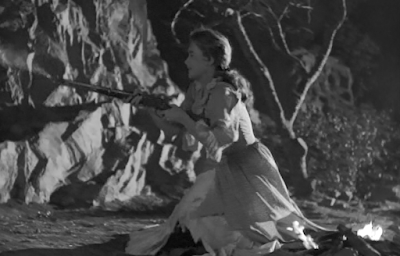
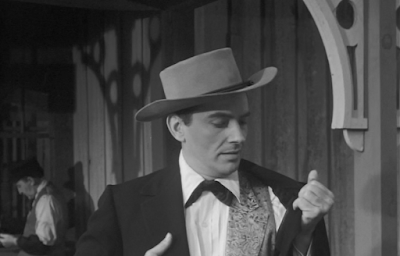
John Ford's 1948 epic Fort Apache is based on the short story Massacre by James Warner Bellah with a screenplay by Frank Nugent.  Tremendous research went into this post-war production with its cavalry setting and myriad of characters.  Following his experiences in WW2 director Ford felt a special bond with the military and the day-to-day life of soldiers and wanted to impart that feeling to the screen.  

Fort Apache tells the story of a Custer-like officer, Colonel Owen Thursday played by Henry Fonda (The Grapes of Wrath).  Col. Thursday feels he has been dismissed politically by a posting in the west with no chance for advancement and glory.  He is an arrogant man, dismissive of others not of his class.  He is ignorant of the native population and unwilling to learn.  20-year-old Shirley Temple (Wee Willie Winkie) plays the colonel's daughter, Philadelphia Thursday.  While the straight-backed Thursday makes an cold first impression with those at the fort, Philadelphia, all dimples, smiles and heart on her sleeve is an instant favourite.  In turn, she is smitten with the newly-minted Lieutenant O'Rourke played by real-life husband at the time John Agar.  The young lieutenant is the pet of the fort being the son of Sergeant Major O'Rourke played by Ward Bond (The Fugitive).  

 
 Shirley Temple, Ward Bond, Irene Rich, Henry Fonda

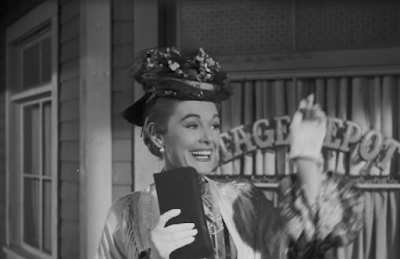
Fort Apache is the story of the people in it.  The ladies of the fort include Anna Lee (How Green Was My Valley) as Mrs. Collingwood and Irene Rich (Desperate Trails) as Mrs. O'Rourke.  They represent home and stability, and perhaps the future for young Philadelphia. 
 
Grant Withers, Victor McLaglen, John Wayne, Henry Fonda
George O'Brien, Miguel Inclan, Pedro Armendariz

Captain Collingwood played by George O'Brien (The Iron Horse) had been expected to become commander of Fort Apache and has a checkered career and history with Thursday.  Captain York played by John Wayne (Stagecoach) is an officer who came up through the ranks with a knowledge of the frontier gained from experience.  Conflicts naturally arise between the by-the-book Thursday and men who have adapted to a rough life outside of the text books.


Shirley Temple, John Agar, Anna Lee, John Wayne
Guy Kibbee, Dick Foran

One of the things I enjoy most about a Ford picture, particularly those with a Nugent screenplay, is that they bring us into a society fully formed to make of it what we will.  Complete biographies for the characters were created before the screenplay was begun and the audience is respected enough to be able to understand the nuances of the dialogue and the shared look among characters.  Of course, being a Ford picture we also have, as in life, humour and music.  It feels absolutely right that a character like Thursday, so hide bound, can be surrounded by the rollicking humour of the sergeants and the recruits.  Although, give him his due, Thursday has one of the funniest lines in the movie when dealing with the larcenous sutler Meachan played by Grant Withers.  The charming musical interlude in Fort Apache is provided by Dick Foran lending his whisky soaked tenor to Sweet Genevieve.


 John Wayne as Kirby York

Archie Stout and William Clothier are the cinematographers who worked on Fort Apache and there are scenes in the desert which are absolutely breathtaking.  I had seen the film quite a few times before realizing how beautiful it is visually.  Fort Apache gives much for the viewer to absorb.  It is an historical piece.  It is a character study.  Perhaps Thursday and York had much they needed to learn from the other.  It has vivid and heartbreaking action.  Fort Apache is full of noble sentiments, and the triumphs and tragedies of every day people.  The stirring epilogue is Ford's presentation to us of when the legend becomes fact, print the legend.  Whether it is for good or not, the legend propels us forward.  

TCM is airing Fort Apache on Sunday, June 17th at 10:30 pm.


Sunday, May 27, 2012

Horseathon: Charlie Chan at the Race Track (1936)

Not a wholesome trottin' race, no!
But a race where they sit down right on the horse!
Like to see some stuck-up jockey boy settin' on Dan Patch
Make your blood boil, well I should say.

Trouble, The Music Man
by Meredith Willson

"Professor" Harold Hill touched a nerve in his Iowan marks who did not share a reverence for the centuries old Sport of Kings.  They would be immune to track promotions highlighting the storied history, the fun to be found in gambling and developing your own system, and the thrill of a race.  The noble horses, colourful characters and high stakes of the stable background are an irresistible setting for a mystery.  Sherlock Holmes had Silver Blaze.  Jockey/author Dick Francis had international best sellers with such titles as Whip Hand and Dead Cert.  And in 1936 Charlie Chan went to the race track.  It had taken a few false starts before Earl Derr Bigger's popular fictional detective of the 1920s took off in film, but at the time of the movie we're looking at today Inspector Chan was, you should pardon the expression, riding high.


"Murder without blood stain like Amos without Andy - most unusual."

H. Bruce Humberstone directed Charlie Chan at the Race Track, the first of four including Charlie Chan at the Opera and Charlie Chan at the Olympics and the first Sidney Toler as Chan outing, Charlie Chan in Honolulu.  "Lucky" Humberstone's career began in the silent era and he assisted the likes of King Vidor and Edmund Goulding.  He was a director who had the ability to constantly entertain audiences with innovative, yet unobtrusive camera work playing to the strengths of his material and keeping the pace sharp so we don't dwell too much on any plot deficits.  Other popular Humberstone films include I Wake Up Screaming, Hello, Frisco, Hello, Wonder Man and To the Shores of Tripoli.

Warner Oland moved to America from his native Sweden with his family while in his teens, made his Broadway debut in 1902 and his screen debut in 1912.  Among his variety of roles was the pious Cantor in The Jazz Singer and the villanous Fu Manchu.  In 1931s Charlie Chan Carries On (an unfortunately "lost" film), Oland found an alter ego that touched his soul.  He approached the role of Inspector Chan through diligent study of Chinese history and philosophy and so fused his personality with that of Chan's that he became the character.  Enduring international fame was Oland's reward for such fidelity of purpose, especially in China, the land of the fictional detective's ancestors.


"Confucius say, no man is poor who has worthy son."

In a master stroke of story and casting handsome and personable artist Keye Luke joined the series in 1935s Charlie Chan in Paris as Lee Chan, number one son.  More than ably handling the action and comedy support, "Lee" also highlighted the main difference between Chan and most mystery protagonists in that he was a family man.  Keye Luke and Warner Oland developed a very close friendship that enhanced the father-son dynamic in the Chan series.  Keye Luke always spoke fondly and admiringly of Warner Oland in interviews, and refused to continue in the series after the death of his friend in 1938.


Frankie Darro

Inspector Chan first becomes aware of the case which will claim his attention through a radio transmission of the Melbourne Cup race to which the staff of the Honolulu Police is riveted.  All the world, it seems, loves a high stakes race.  At the behest of son Lee, Chan even bets 50 cents on the "schnozzola" of the favourite, Avalanche, owned by old friend Major Kent played by the aristocratic George Irving.  The 50 cents is lost when Avalanche was disqualified because of a foul committed by perennial movie jockey Frankie Darro (Wild Boys of the Road, Pinocchio).


Jonathan Hale, Helen Wood, Gloria Roy, Alan Dinehart, Thomas Beck

Although Major Kent has sold his interest in Avalanche to his son-in-law George Chester played by Alan Dinehart, Kent was determined to expose the gambling ring he felt was behind the disgrace.  He cabled Inspector Chan to meet the party as they stopped in Honolulu on their way to a meet in Los Angeles.  On shipboard Major Kent is killed and the blame placed on the high strung Avalanche.  Chan determines it is a case of murder and joins the cruise to pursue his investigation.  Lee signs on as cabin boy to assist and protect his "Pop".  The cruise provides a glamorous setting with moonlight on the water, fashionably gowned ladies, dinner jacketed gents, fires in the hold and near fatal gun attacks.


Frank Coghlin, Jr.

Our suspects include owners, trainers, jockeys, touts and stable boys and are brought to life by a pleasing and thoroughly professional cast of players. Canadian born Jonathan Hale (Mr. Dithers in the Blondie series, Inspector Fernack in The Saint) is rival horse own Warren Fenton.  His "dark horse" Gallant Lad bears a striking resemblance to the highly favoured Avalanche.  G.P. Huntley (Dressed to Kill, Charge of the Light Brigade) is a gambler who may be too smart for his own good.  Gavin Muir (Hitler's Children, Wee Willie Winkie) is a trainer with an agenda.  Frank Coghlin Jr. (Adventures of Captain Marvel) is a nice guy jockey with more heart than sense.  John Henry Allen is the stable boy "Streamline", always referred to as "Mister Streamline" by Inspector Chan.  Streamline has more to deal with than he wants with nervous horses, an overbearing owner and a rambunctious monkey named Lollipop. Paul Fix (To Kill a Mockingbird, The Rifleman), as he always played in the 30s, is a weasely gun man.  Gloria Roy, in the fourth of seven Chan appearances, plays a woman in the middle of it all as the daughter of Major Kent and wife of George Chester.  Helen Wood is our pretty ingenue, the daughter of rival horse owner Warren Fenton and romantic interest of secretary Thomas Beck (Heidi, Champagne Charlie) in the second of three Chan features, and soon to leave Hollywood after a contract dispute.


Helen Wood, Thomas Beck

Charlie Chan 101 for Newbies:  If there is a young romantic couple, and there always is a young romantic couple, you can erase them from your suspect list.  They are included only to be young and romantic.


Gavin Muir, Paul Fix, "Lucky" Humberstone behind seated Frankie Darro

Charlie Chan has dealt with dope rings, spies, maniacs, blackmailers and all sorts of criminals.  The gambling ring in Charlie Chan at the Race Track are as cold a group of birds as the Inspector ever came up against.  Director Humberstone stepped in front of the camera to become one of the gang.  Ruthless and determined, part of their plan includes switching Avalanche and the similarly built Gallant Lad in a bid to rig bets.


The inventiveness of equine appellations gives me great pleasure.

A climactic race is featured in the solution of Charlie Chan at the Race Track filmed at Santa Anita Park and Racetrack, named Santa Juanita for the movie.  So many questions must be answered.  Is the gambling syndicate behind all the evils?  Is Fenton the mastermind?  Is Chester as innocent as he seems?  Are Fenton and Chester in cahoots?  Are they cahooting with the crooks?  Will harm come to Avalanche or Gallant Lad?  Will Charlie Chan bring the criminal element to justice?  You can safely put your 50 cents on the old schnozzola.

Enjoy all the delightful looks at movies, horses and movie horses at the first ever Horseathon sponsored by Page of My Love of Old Hollywood.


Thursday, May 17, 2012

Favourite movies: The Italian Straw Hat (1928)

 Albert Prejean

Un chapeau de paille d'Italie was a very successful 1851 play written by Eugene Labiche and Marc Michel.  Labiche's family had intended for him to follow a career in law, but in his heart he was an author and, with the blessing of his wife, he followed his heart to success in the theatre.  "Of all the subjects," he said, "which offered themselves to me, I have selected the bourgeois. Essentially mediocre in his vices and in his virtues, he stands half-way between the hero and the scoundrel, between the saint and the profligate."  Audiences both laughed with and at the travails of Ferdinand and his various family, friends and sudden acquaintances in The Italian Straw Hat as Fate, with a capital "F", steps in to ruin his wedding day.

Rene Clair

Producer Alexandre Kamenka chose the perfect director for the 1928 production of The Italian Straw Hat in Rene Clair.  Clair changed the setting of the 1851 farce to 1895 Paris and treated the audience to a peek at the foibles and pretensions of the middle class.

Olga Tschechowa, Geymond Vital

Ferdinand and Helene are to be married.  Relatives are readying themselves for the ceremony and reception.  Buttons refuse to be hooked.  Gloves have gone missing.  Shoes are too tight.  Collars come loose.  Gifts are scrutinized.  Hopes are high.  Frustrations are plentiful.  Ferdinand avails himself of the fresh air in the countryside.  A lady, Madame De Beauperthuis and her lover Lt. Tavernier are also availing themselves of the, uh, fresh air.  The lady's lovely straw hat has been placed delicately on the shrubbery where Ferdinand's horse finds it irresistible.  The dashing lieutenant demands that Ferdinand replace the hat exactly as it is a rare and recognizable hat that was a gift from the lady's husband and should he find it missing, the lady will be compromised.  And - we're off to the races.

Ferdinand must find the lady a suitable replacement.  He must keep her identify a secret.  He must also get married, attend his reception and keep his wife and everyone he has ever met happy and "in the dark" about his predicament.

Ferdinand's valet tries to stop the marauding relatives.


Such fun!  Such wonderfully humourous scenes in the silent comedy!  The wedding ceremony at the City Hall enjoyed most of all by the deaf uncle.  The dancing at the reception with the twirling assemblage and close-ups of the nervous Ferdinand.  The overwrought lieutenant threatening to destroy everything in Ferdinand's house.  The befuddled and helpful stranger who turns out to be the lady's husband!  The suspicions of the family and new bride who proceed to empty the home of wedding gifts.  These are the sorts of situations you might think would work best through pithy dialogue delivered with a wink.  However, nothing is lost and perhaps more is gained by the delightful cast and their thoroughly professional and inventive director in this treasure of a silent comedy.  A highly recommended, laugh-out-loud winner.     

Tuesday, May 15, 2012

Lucky 7 X 7


It has been a couple of weeks since that eminent Man of Letters, Lee Price, honoured this corner of the blogosphere with the 7 X 7 Link Award.  I vaguely recall blushing, sharing the good news with my family and promising to follow-up with the responsibilities of the recipient.  Well, as happens with all of us, there are times when the blog is your life and times when life gets in the way of your blog. 

The first duty of the recipient is to thank the giver and that I do most happily.  Thank you, Lee, friend of my IMDb days and beyond.  If you choose to take a look at the Blog list on the right, you will find two of Lee's contributions to the blogging world to visit, 21 Essays and Art and June.  I am pleased to know that you will thank me for pointing you in their direction. 

 No. 2 encourages the recipient to share seven random facts about themselves.  H'm.
  • I consider toast and peanut butter to be a delicacy, and gravy a beverage.
  • As a child I thought that being an adult meant that your feet would touch the floor when you sat down.  This has not proven to always be the case.
Beatrice, Rosemary
  • I am the "grandmother" of two cats, Beatrice, named for the "B" in J.B. Fletcher, and Rosemary, named for Miss Clooney of musical fame.
  • I alphabetize my movie/tv show collection.
  • I am at the stage of life where I don't know who any of the major baseball players are, but I recognize the coaches.
  • Jerome Moross' theme for Wagon Train can make me cry.
  • I am afraid of heights. 


The 3rd responsibility is one that requires some thought.  It is to share seven of your posts under the following headings:


The 4th responsibility is to nominate seven other bloggers and notify them.  A click on the CMBA logo or a look at my Blog List let's you know of many of the interesting and fascinating writers I follow.  Today I will pass along the 7 X 7 Link Award to these folks, may they accept it in the spirit it is intended, and follow-up as they choose.  I will say that it is an interesting exercise to consider your own work under the  provided headings.

Happy reading, all.  Thanks again, Lee.


Thursday, May 3, 2012

Bing's Birthday Movie: The Emperor Waltz (1948)

We have once again come to that rolling time of the year when this corner of the internet celebrates Bing Crosby's birthday.  There has long been confusion about the date.  According to biographer Gary Giddins, Harry and Kate Crosby's fourth son was born on May 3rd, 1903.  The proud parents had the announcement placed in a local paper, but it was published on the 5th and contained the word "yesterday" making it appear the future "Bing" was born on the 4th.  A correction was asked for and received from the paper.  Later Paramount Studios publicity would use May 2nd as the date and 1904 as the year at the behest of manager/brother Everett Crosby.  In 1906 on May 3rd Bing's younger sister Mary Rose was born.  The young lady was most put out by having to share a birthday with anyone else and her brother happily relinquished the date.  Just like a kid!  No consideration for future biographers, astrologers or bloggers.

Today, along with birthday cake, let's take a look at the 1948 release The Emperor Waltz.  A Technicolor musical written by Billy Wilder and Charles Brackett and directed by Wilder, The Emperor Waltz is not one of those classic Crosby movies that even non-fans recall, nonetheless I find it to have a certain charm and worth the time of the viewer.  There are few writer/directors I admire more than Billy Wilder and few entertainers I enjoy more than Bing Crosby. I don't know what I expected when they got together, but I guess it wasn't The Emperor Waltz. Initial disappointment was erased on a recent viewing.

Our story is set in the long ago Austria of Emperor Franz Josef and concerns the love affair between a haughty widowed Countess Johanna Augusta Franziska played by Joan Fontaine and a brash American salesman Virgil Smith played by Bing Crosby. Ditto her purebred poodle and his mutt. There is a lot of talk about class differences and bloodlines and, through the years, this has been my major gripe with the script. Perhaps at the time in the late 40s Brackett and Wilder felt the need to make some sort of a statement, but it's a tad heavy handed and detracts from the fun - and there is fun.


The musical numbers are presented wittily and include Friendly Mountains (a yodeling song), The Emperor Waltz with Johnny Burke lyrics to Johann Strauss' melody and Jimmy Van Heusen and Burke's Get Yourself a Phonograph, the phonograph being Virgil's stock-in-trade.  The old standby I Kiss Your Hand, Madame starts with Bing's vocal, then brings in a piano, then two policemen pick up violins and then the domestic staff starts to dance. When our countess swoons after a few boo-boo-boo's, you know it's all in fun. Billy Wilder having friendly fun with operetta and musical film conventions.  The uninspired humorist often remarks when watching a musical "where did the orchestra come from?". There is no need to ask in the enchanting The Kiss in Your Eyes as an entire village puts bow to string to accompany this most stirring of love songs with lyrics by Johnny Burke to the melody from Richard Heuberger's Im Chambre separee from his 1898 operetta Der Opernball.  It is one of the loveliest ballads Bing ever recorded and and it is followed in the movie by a grand punchline from the Countess.

The Technicolor is sumptuous and truly befitting the operetta-like sensibility of the movie.  Location filming was done in Jasper National Park in Alberta.  Apparently Wilder had pines transplanted from California, not being satisfied with our Canadian trees.  One one hand I am mildly insulted, but on the other I am amazed at the resources of the studio.

Joan Fontaine

Joan Fontaine is evry inch the royal lady, looking lovely in her costumes and easily handling the comic and dramatic portions of the script.  A nice transition from her young, vulnerable characterizations to the more confident and sophisticated females she portrayed in the 50s.

Early in the film Bing tends to shout his way through Virgil, but his character is a lone fish out of water with no kibitzing pal such as a Bob Hope or Barry Fitzgerald.  Once he starts to sing - well, like the Countess, it is easy to fall for the go-getting salesman.  Lucile Watson (The Women, The Thin Man Goes Home) is an absolute delight as a dowager princess with a penchant for storytelling and for our Countess' profligate father played in fine style by Roland Culver (The Life and Death of Colonel Blimp, The Holly and the Ivy). 

Bing Crosby, Richard Haydn

The top performance comes from Richard Haydn as Emperor F-J himself.  Unrecognizable under the whiskers and make-up, and foregoing his famous precise nasally delivery, Mr. Haydn gives us a very interesting Franz-Josef.  A petulant, funny, irritating, thoughtful and memorable character.  You will pinch yourself to be reminded of whom you are watching.  Mr. Haydn would later direct co-star Crosby in the 1950 comedy-romance Mr. Music.

Personally, the negatives I find in the movie are the somewhat overly-preachy aspects of the script, which may have been due to censorship issues, and a tendency to drag in spots.  Those aspects are more than made up for by the accomplished actors, lovely music (Oscar nomination for Victor Young for Best Scoring), gorgeous scenery, sumptuous cinematography (George Barnes) and grand costumes (Oscar nominations for Edith Head, Gile Steele).  Perhaps if the Academy had recognized Richard Haydn, he  would have received a nomination as well.

Celebrate, everyone!  Enjoy that cake and slip that Crosby disc on or in whatever music making machine is at your disposal.


Monday, April 30, 2012

Caftan Woman's Choice: One for May on TCM

Stars in My Crown (1950) is Joe David Brown's adaptation of his 1947 episodic novel featuring stories which previously appeared in The Saturday Evening Post.  The screenplay is by Margaret Fitts whose other scripts include The Sun Comes Up, Talk About a Stranger and the adaption of her own novel The King and Four Queens.

Stars in My Crown is a nostalgic story where a man recalls his youth and the importance of his mentor, Parson Josiah Gray.  In the novel, the parson is the grandfather.  In the film, Parson Gray played by Joel McCrea is the adopted uncle of the orphaned John Kenyon played by Dean Stockwell.  Ellen Drew is the youngster's loving Aunt Harriet.

The tone for the film directed by Jacques Tourneur (I Walked With A Zombie, Cat People, Canyon Passage, Nightfall, etc.) is set right from the top as an unseen congregation sings the parson's favourite hymn, Stars in My Crown.

I am thinking today of that beautiful land
I shall reach when the sun goeth down
When through wonderful grace by my Saviour I stand
Will there be any stars in my crown
Will there be any stars any stars in my crown
When at evening the sun goeth down
When I wake with the blest in those mansions of rest
Will there be any stars in my crown . . .


The narrator, Marshall Thompson as the adult John Kenyon, greets us with these words : -

"Do you hear that?  You might say I was raised on that song.  It takes me back - back to the old times when I was young - back to Walesburg.  According to the words of the song we're promised a City of Gold in the hereafter.  I used to think that was a long time to have to wait, but I know now that there is a City of Gold right here on earth for every one of us.  The city of our youth.  Walesburg is only one name for it that's all.  Walesburg not as it is now but as it used to be.  I just have to shut my eyes and I'm there.  Nothing's changed.  I'm always a boy in Walesburg.  There at my side, as he'll always be, is the parson.  Parson Gray."
 
Dean Stockwell, Joel McCrea, Juano Hernandez 

We meet the people of Walesburg and follow their stories as John recalls them with both the clear eyes of uncensored youth and the nostalgic glow for a time past.  We meet the sweet and pretty schoolteacher, Miss Samuels played by Amanda Blake and her beau, the opinionated young doctor played by James Mitchell.  There is Juano Hernandez's Uncle Famous who dispenses understanding and fishing tips to growing boys.  Charles Kemper's Professor Jones the traveling medicine show man.  The parson's best friend farmer Jed Isbell played by Alan Hale and his five tow-headed sons.  There's the town's ruthless businessman Lon Backett played by Ed Begley.  Arthur Hunnicut as the town character Chloroform Wiggins and Jack Lambert as the town bully Perry Lockey.  Their stories play out through greed and illness, through acts of kindness and acts of courage.
 
James Mitchell, Amanda Blake 

The young Dr. Harris has inherited his position in town sadly from the passing of his father.  The senior Dr. Harris had the confidence and love of Walesburg.  The junior Dr. Harris has, in the words of his father "A lot of education, but very little sense."  Conflict and heartbreak will be his maturing with the help of Parson Gray.


Dr. Harris Jr.:  As long as I am doctor in this town you will oblige me by asking my permission before you interfere with my patients.
Parson Gray:  I came out here tonight because I was sent for, same as you.  We'll be meeting like this right along now and you may as well get used to it.  Souls don't always enjoy perfect health you know - any more than bodies do.
Dr. Harris Jr.:  Well, I'm not interested in souls, Mr. Gray.  And when I want a sermon on the subject I'll come to church for it.
Parson Gray:  Good.  I'll be glad to preach  you one.

The stories of Stars in My Crown are played out at a gentle pace befitting the backwards view.  When silence is all that is necessary, as at the side of a sick bed, we see the experience in silence.  When dialogue is necessary, it is amusing as when the parson diffuses a difficult situation with a humourous anecdote.  It may be revealing as in the relationships between the parson and his friend Jed or the parson and his devoted and clear-eyed wife.

There are wonderful scenes between the young John and his friend Chase Isbell played by Norman Ollestad (Sky King) as they philosophize as only the young may.  One scene features the lads riding a hay wagon with the sunlight dappled through the treetops.  The B&W cinematography by Charles Schoenbaum gives you the feel of the warmth of the sun and the scratchiness of the hay.

In both the novel and the movie, one of the most moving scenes and challenges to Parson Gray is dealing with the ambitions of Lon Backett to force Uncle Famous from his land over mining rights.  The Klan is organized to frighten the old man and when that doesn't work, murder is in their hearts threatening the very soul of Walesburg.

Parson Gray will not use guns and will not accept help as he faces the evil.  The first time I read the book, I was reading that section in public and could not hold back my tears.
 
"Night Riders.  Yellowbacks in fancy dress!  You shame me and you shame the Lord that made you and called you men.  And if I wasn't His servant I'd take a buggy whip to the lot of you." 

When Stars in My Crown ends, it ends much too abruptly for my liking although all of the stories that wanted telling have been told.  Perhaps, like John Kenyon, I want to spend a longer time in Walesburg.  There is not a false moment in any of the performances and the people and emotions are genuine.  Joel McCrea often sited Stars in My Crown as a favourite among his films and director Jacques Tourneur so loved the story that he offered to work on the film for scale, which may have tarnished his reputation among studio executives.  Nonetheless, he left us a true classic film.

I can't help but wonder if during the filming second lead Amanda Blake took any notice of a gangly young man with an engaging smile who was the tallest of Alan Hale's brood.  Could she possibly have imagined that inside of a decade she and James Arness would make television history as 19 year co-stars as Kitty Russell and Matt Dillon?  Before any regular visitors to this blog ask, the answer is yes.  All roads lead to Gunsmoke.

TCM is screening Stars in My Crown on Wednesday, May 16th at 12:45 AM.  I hope they will pardon my saying that I believe the movie deserved a prime time spot during Joel McCrea month. 
    

Wednesday, April 25, 2012

Jack Albertson and the Movie Buff Moment

I started out in vaudeville, and vaudeville died.  I hit the burlesque houses and they padlocked 'em.  I tried radio, and you know what happened to radio.  Then live TV, and it vanished.  Now that I've finally got a toehold in movies, look what's happening to them.  - Jack Albertson (1907 - 1981)

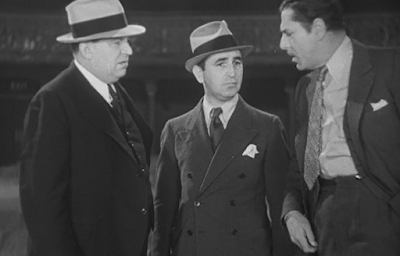
Massachusetts born Jack Albertson, and his sister Mabel, inherited the show business gene from their mother who appeared in stock.  I don't imagine Jack's Russian-Jewish immigrant parents were too impressed when their son left high school to pursue life upon the wicked stage, but they probably understood.  In those early years perhaps Jack himself often wondered why he kept at it when he wasn't making enough money to put a roof over his head and had to wonder where the next sandwich was going to come from.  However, people like to be entertained and this versatile and willing performer persevered.  By the 1950s High Button Shoes and Top Banana would see Jack on Broadway with Burlesque compatriot Phil Silvers.  Television audiences would start to recognize him on shows such as The Jack Benny Program, The Dick Van Dyke Show, The Twilight Zone, The Many Loves of Dobie Gillis, Mr. Ed and more.  He played his share of reporters, doctors and desk sergeants in movies.  And one very famous postal worker who can be seen every Christmas season sending bags of letters to Santy Claus at the courthouse in Miracle on 34th Street.  Jack Albertson was working steadily, but if he had early dreams of acclaim and awards - well, that time was probably past.  

Enter Frank D. Gilroy's The Subject Was Roses in Broadway's 1964 season.  The three person character study won Best Play from the Tony Committee.  Young Martin Sheen was nominated for Featured Actor in a Play and Jack Albertson won the award in that category.  The 1968 film of the play brought both actors to the screen with Patricia Neal replacing stage star Irene Daily.  Ms. Neal was nominated for a Best Actress Oscar and Jack Albertson won Best Supporting Actor.
 
  Amanda Blake, Jack Albertson
Gunsmoke

Suddenly, in his 60s, Jack Albertson wasn't "that guy playing the cop or neighbour".  He was the special guest star on series with episodes written for his character such as "Danny" who had a mysterious hold on Kitty's affection in Gunsmoke or a pool shark on Ironside: "Side Pocket".  Five Emmy nominations and two wins would come his way for guest spots and the sitcom Chico and the Man.  Popular film roles would rack up with The Poseidon Adventure, Willie Wonka and the Chocolate Factory and The Fox and the Hound.  Jack Albertson certainly had a career to be proud of.

  Gavin Hall
Easy to shop for!
 
My boy Gavin has his challenges with autism/developmental delay.  He has limited independent language skills, but if you take the time you will find him to have a good memory and a rollicking sense of humour.  He is also a movie buff.  My husband and I often fight over which side of the family Gavin gets his good looks from, but we know beyond the shadow of a doubt he gets the movie buff gene from me.

Gavin is also imaginative.  He invented the alternate casting game.  He must have invented it because no one has every played it with him.  Gavin likes to write out the casts of his favourite movies and get his dad, sister Janet or I to read the list aloud.  Every so often Gavin will throw in a ringer and watch for our reaction.  For instance, in The Jungle Book he'll put Hans Conried as Colonel Hathi (Everybody knows J. Pat O'Malley was the voice of Colonel Hathi!).  Gavin watches us with wide eyes waiting to see our reaction.  He's so proud of us when we catch it.  By the way, wouldn't you agree that Billy Gilbert and Martin Short would have been fine as "a monkey" in The Jungle Book?

 
 Jack Albertson - Amos Slade
The Fox and the Hound

Last weekend Gavin was in a The Fox and the Hound mood.  That means if you are not in a The Fox and the Hound mood, you are in for a rough time because that is all that will be playing for hours.  The weekend also brings one of Gavin's favourite activities which is going to the library with Daddy and borrowing a movie.  After his last trip to the library Gavin bounded into the house clutching Willie Wonka and the Chocolate Factory.  He made us sit in the living room.  He turned on the disc of The Fox and the Hound and paused at the credit "Jack Albertson - Amos Slade".  He replaced the disc with Willie Wonka and the Chocolate Factory and paused at the credit "Jack Albertson" and turned with triumph in his eyes to see our reaction.   "Yes" we told him.  "Jack Albertson - Amos Slade and Jack Albertson - Grampa Joe."

 
 Jack Albertson - Grampa Joe
Willy Wonka and the Chocolate Factory

It may not have been the Helen Keller "water" moment, but what movie buff can't relate to the "Aha!" of discovery.  It brought me back to the glorious day when it finally dawned on me that Irving Bacon, Olin Howland and Tom Fadden were not the same guy.  It was an exciting moment for my boy and it was gratifying that he wanted to share.  I may have gotten a little carried away because Gavin gently let me know that although he was pleased that I understood his joy, the hug was too much and a high five would suffice.  I'll gladly take that high five and the movie buff connection with my son.  If he must have a label - and apparently he must - let it be Gavin Hall, movie buff.